
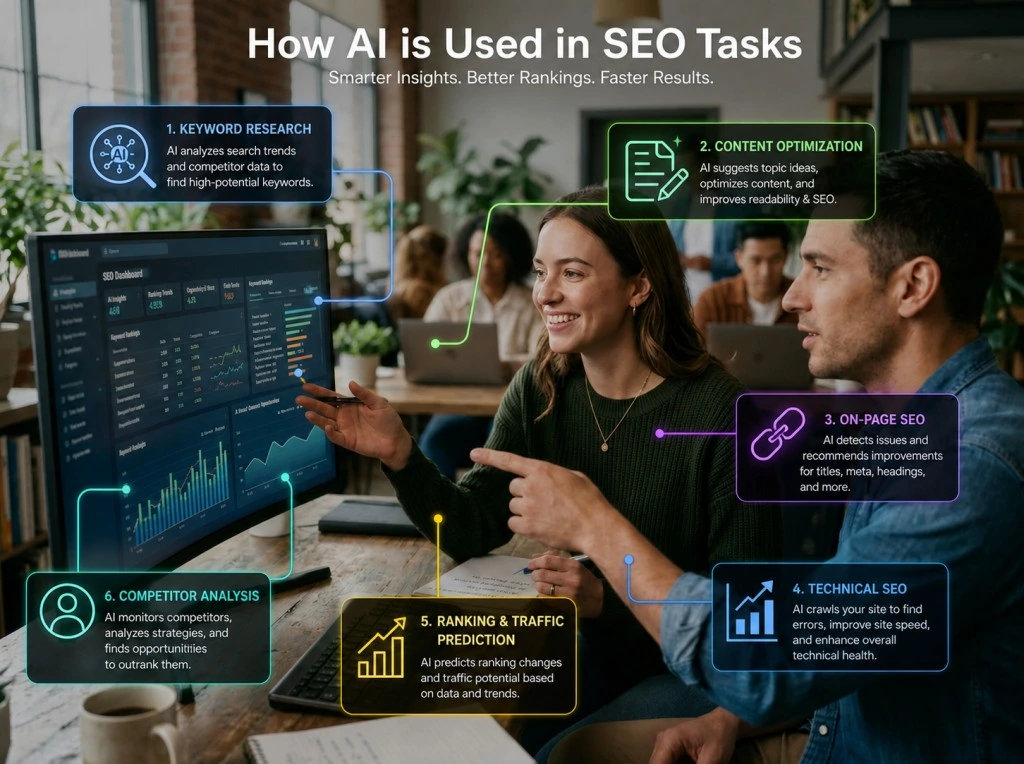
Artificial intelligence (AI) has transformed nearly every aspect of digital marketing, and search engine optimization (SEO) is no exception. In 2026, AI is not just a supporting tool—it is a driving force behind how search engines rank content, how marketers create strategies, and how users discover information online.
From AI-powered search algorithms to content generation and predictive analytics, businesses now operate in an environment where data and automation play a central role. While this shift creates powerful opportunities, it also introduces new risks that businesses must navigate carefully.
Understanding the role of AI in modern SEO is essential for staying competitive, making informed decisions, and building sustainable strategies that align with both search engines and user expectations.
How AI Is Reshaping SEO in 2026
Search engines have evolved far beyond simple keyword matching. AI systems now analyze context, intent, and user behavior to deliver more relevant results.
Google’s advancements in machine learning, including systems like RankBrain and natural language processing models, allow search engines to understand:
- The meaning behind search queries
- The relationships between topics
- User satisfaction signals such as engagement and dwell time
According to Google Search Central, modern SEO is less about optimizing for algorithms and more about creating helpful, user-focused content.
AI has shifted the focus from technical tricks to holistic optimization, where quality, relevance, and experience matter most.
Opportunities: How AI Enhances SEO Strategies
AI offers significant advantages for businesses that know how to use it effectively. It enables faster insights, better content creation, and more precise targeting.
1. Smarter Keyword and Topic Research
Traditional keyword research tools provided lists of search terms. AI-powered tools now go further by analyzing intent, clustering related topics, and identifying content gaps.
Platforms like SEMRush and Ahrefs use AI to:
- Group keywords by intent and relevance
- Predict search trends
- Identify opportunities competitors may have missed
This allows businesses to create content that aligns more closely with what users are actually searching for.
2. AI-Assisted Content Creation
AI tools can help generate content ideas, outlines, and even drafts. This speeds up the content creation process and helps maintain consistency.
However, the real value lies in augmentation, not replacement. AI can assist with:
- Structuring articles
- Generating topic ideas
- Improving readability and grammar
Over 60% of marketers in 2026 use AI tools to support content creation, highlighting its growing importance.
3. Predictive Analytics and Trend Forecasting
AI can analyze historical data to predict future trends. This helps businesses stay ahead of changes in search behavior and algorithm updates.
For example, predictive analytics can:
- Identify emerging keywords before they peak
- Forecast seasonal trends
- Highlight content opportunities based on user behavior
This proactive approach allows businesses to create content before demand becomes saturated.
4. Enhanced User Experience (UX) Optimization
AI plays a key role in improving user experience, which is a critical ranking factor. Tools powered by AI can analyze user behavior and suggest improvements to:
- Page layout and navigation
- Load times and performance
- Content structure and readability
According to Think with Google, improving user experience can significantly increase engagement and conversion rates.
5. Automation of Repetitive SEO Tasks
AI helps automate time-consuming tasks, allowing marketers to focus on strategy. These tasks include:
- Technical audits
- Rank tracking
- Content optimization recommendations
- Reporting and analytics
Automation increases efficiency while reducing the risk of human error.
Risks: Challenges of AI in SEO
While AI offers many benefits, it also introduces risks that businesses must manage carefully.
1. Over-Reliance on AI-Generated Content
One of the biggest risks is relying too heavily on AI to create content. While AI can produce large volumes of text quickly, it may lack:
- Original insights
- Human perspective
- Contextual accuracy
Search engines are becoming better at identifying low-quality or generic content. Content that lacks originality and expertise is less likely to rank well, regardless of how it is generated.
2. Loss of Brand Voice and Authenticity
AI-generated content can sound generic if not carefully edited. This can dilute your brand identity and make it harder to connect with your audience.
Maintaining a consistent tone and voice is essential for building trust. Businesses should use AI as a tool, not a substitute for human creativity.
3. Ethical and Accuracy Concerns
AI tools can sometimes produce incorrect or misleading information. This poses a risk, especially for industries where accuracy is critical.
Businesses must:
- Fact-check AI-generated content
- Ensure information is up to date
- Provide credible sources
Maintaining accuracy is essential for building trust and meeting EEAT standards.
4. Increased Competition
AI lowers the barrier to content creation, meaning more businesses can produce content at scale. This increases competition in search results.
To stand out, businesses must focus on:
- Unique insights
- High-quality, authoritative content
- Strong branding and differentiation
Simply producing more content is no longer enough.
5. Dependence on Algorithms
As AI becomes more integrated into search engines, businesses may feel pressure to constantly adapt to algorithm changes.
However, focusing too much on algorithms rather than users can lead to short-term tactics that are not sustainable.
Balancing AI With Human Expertise
The most effective SEO strategies in 2026 combine AI capabilities with human expertise. This balance ensures content is both efficient and meaningful.
Human input is essential for:
- Strategic decision-making
- Creative storytelling
- Industry expertise and insights
- Building authentic connections with audiences
AI provides the tools, but humans provide the context and value.
Best Practices for Using AI in SEO
To maximize benefits while minimizing risks, businesses should follow these principles:
- Use AI to support research and analysis, not replace strategy
- Always review and edit AI-generated content
- Focus on user intent and value rather than volume
- Combine data insights with human creativity
- Continuously monitor performance and adjust strategies
These practices ensure AI enhances your SEO efforts without compromising quality.
The Future of AI and SEO
AI will continue to shape SEO in the coming years. Emerging trends include:
- More personalized search results
- Greater integration of voice and visual search
- Increased use of AI-generated summaries in search results
- Advanced predictive analytics for content planning
Businesses that adapt to these changes will be better positioned to succeed in an increasingly competitive digital landscape.
Final Thoughts
AI has become a powerful force in modern SEO, offering opportunities to improve efficiency, enhance user experience, and gain deeper insights. However, it also introduces challenges that require careful management.
In 2026, successful SEO strategies are not driven by AI alone—they are built on a combination of technology, expertise, and user-focused thinking. Businesses that strike this balance can leverage AI to their advantage while maintaining quality, authenticity, and long-term growth.
Want to leverage AI for smarter, more effective SEO without sacrificing quality?
Great Scott Marketing helps businesses integrate AI into their SEO strategies while maintaining the expertise, creativity, and trust needed to succeed in 2026 and beyond.
0 Comments